Currency Crossroads: How Arab Wealth Managers Are Rethinking Dollar Dependency in a Multipolar World
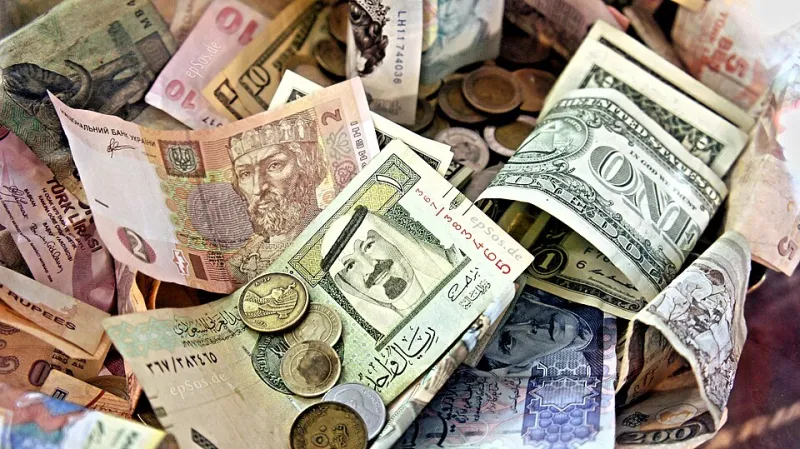
Photo: epSos.de, CC BY 2.0, via Wikimedia Commons
For decades, the US dollar functioned as something close to a universal constant in Arab investment portfolios. Sovereign wealth funds, family offices, and private wealth managers throughout the Gulf and Levant treated dollar-denominated assets not merely as an allocation decision, but as a foundational assumption. That assumption is now being revisited with unusual urgency.
The dollar's share of global foreign exchange reserves has declined from roughly 71 percent in 2000 to approximately 58 percent today, according to International Monetary Fund data. While that figure still reflects overwhelming dominance, the trajectory has captured the attention of long-horizon investors who are paid to anticipate structural shifts rather than react to them. Among the most active in responding to this trend are Arab wealth managers, whose institutional clients are uniquely positioned at the intersection of petrodollar flows, geopolitical realignment, and growing bilateral trade in non-dollar currencies.
The Catalyst Behind the Recalibration
Several converging forces have accelerated this rethinking. The weaponization of dollar-denominated payment infrastructure following Russia's 2022 invasion of Ukraine sent a clear message to governments and investors worldwide: proximity to US financial systems carries not only opportunity but also sovereign risk. For Gulf states that maintain complex diplomatic relationships with multiple global powers, that lesson was absorbed quickly.
Simultaneously, persistent US fiscal deficits, the trajectory of federal debt, and cycles of aggressive Federal Reserve policy have introduced new uncertainty around long-term dollar purchasing power. Arab institutional investors, many of whom operate across generational time horizons, are structurally sensitive to this kind of slow-moving but compounding erosion.
And then there is the practical dimension of trade. As Gulf states deepen commercial relationships with China, India, and ASEAN economies — relationships increasingly settled outside of SWIFT corridors — the logic of holding reserve assets in currencies that reflect actual trade flows becomes more compelling.
What the Reallocation Actually Looks Like
It would be a mistake to characterize this shift as a wholesale retreat from the dollar. Arab investors continue to maintain substantial US equity, Treasury, and real estate positions. The change is more nuanced: a deliberate reduction in concentration risk, executed through a widening array of alternative instruments.
Commodity-Backed Positioning
Gold has re-emerged as a core holding rather than a peripheral one. Several Gulf-based family offices have increased their physical gold allocations meaningfully over the past two years, viewing the metal not as a speculative play but as a structural hedge against fiat currency debasement. This mirrors the behavior of central banks globally, which purchased gold at near-record levels in 2022 and 2023.
Beyond gold, some Arab wealth managers are exploring exposure to commodity baskets — including energy, agricultural inputs, and industrial metals — as a form of real-asset currency. The logic is straightforward: if the dollar weakens in purchasing power terms, hard assets priced in dollars tend to appreciate in dollar terms, providing a natural offset.
Renminbi-Denominated Instruments
China's push to internationalize the yuan has found a receptive audience in parts of the Arab investment community, particularly among institutions with existing commercial ties to Chinese counterparties. Saudi Arabia's willingness to discuss yuan-settled oil transactions — even if not yet standard practice — has opened a conceptual door. Arab investors are now exploring renminbi-denominated bonds, known as dim sum bonds, as well as direct participation in China's onshore capital markets through qualified foreign investor channels.
This is not without complexity. Capital controls, regulatory opacity, and geopolitical risk associated with China's own strategic ambitions give pause to many managers. The allocation is typically modest — a single-digit percentage of total portfolio — but it represents a meaningful philosophical departure.
Emerging Market Debt in Local Currencies
Beyond China, Arab wealth managers are increasingly comfortable with sovereign and corporate debt issued in currencies such as the Indian rupee, Indonesian rupiah, and Brazilian real. These instruments offer yield premiums over US Treasuries while providing exposure to economies that are, in many cases, growing faster than the developed world. Currency risk remains a central concern, but managers are using a combination of hedging strategies and natural diversification across multiple EM currencies to manage volatility.
Maintaining the US Connection
Critically, none of this represents a disengagement from American markets. The US equity market, with its depth, liquidity, and concentration of globally dominant companies, remains central to most Arab institutional portfolios. What is changing is the currency and asset-class composition of the surrounding portfolio — the non-US portion that now plays a more active role in managing overall risk.
Some wealth managers describe this as building a "currency buffer" around their core US holdings. By holding assets that either appreciate when the dollar weakens or that generate returns in non-correlated currency environments, they aim to preserve purchasing power globally even if US-centric returns face headwinds.
There is also a tactical dimension. For Arab investors who generate income in Gulf currencies pegged to the dollar, a weaker dollar environment can actually reduce real returns when those earnings are deployed internationally. Diversifying reserve holdings into other currencies partially insulates the overall portfolio from this structural exposure.
The Road Ahead
The dollar's reserve currency status is not disappearing on any near-term timeline. The depth of US capital markets, the rule of law framework, and the sheer scale of global dollar-denominated debt create powerful structural inertia. Any credible alternative — whether the renminbi, a digital reserve currency, or a commodity-backed instrument — faces decades of institutional development before it can genuinely challenge dollar primacy.
But Arab investors are not betting on the dollar's collapse. They are, with characteristic long-term discipline, building portfolios that do not require the dollar to remain dominant indefinitely in order to preserve and grow wealth. That distinction — between catastrophizing and prudent diversification — is what separates sophisticated currency risk management from reactive speculation.
For Arab wealth managers advising clients across the Gulf and Levant, the question is no longer whether to diversify away from pure dollar concentration. The question is how to do so with precision, patience, and a clear-eyed view of the genuine risks on both sides of the trade.