Towers of Capital: The Quiet Transformation of US Commercial Real Estate by Middle Eastern Investors
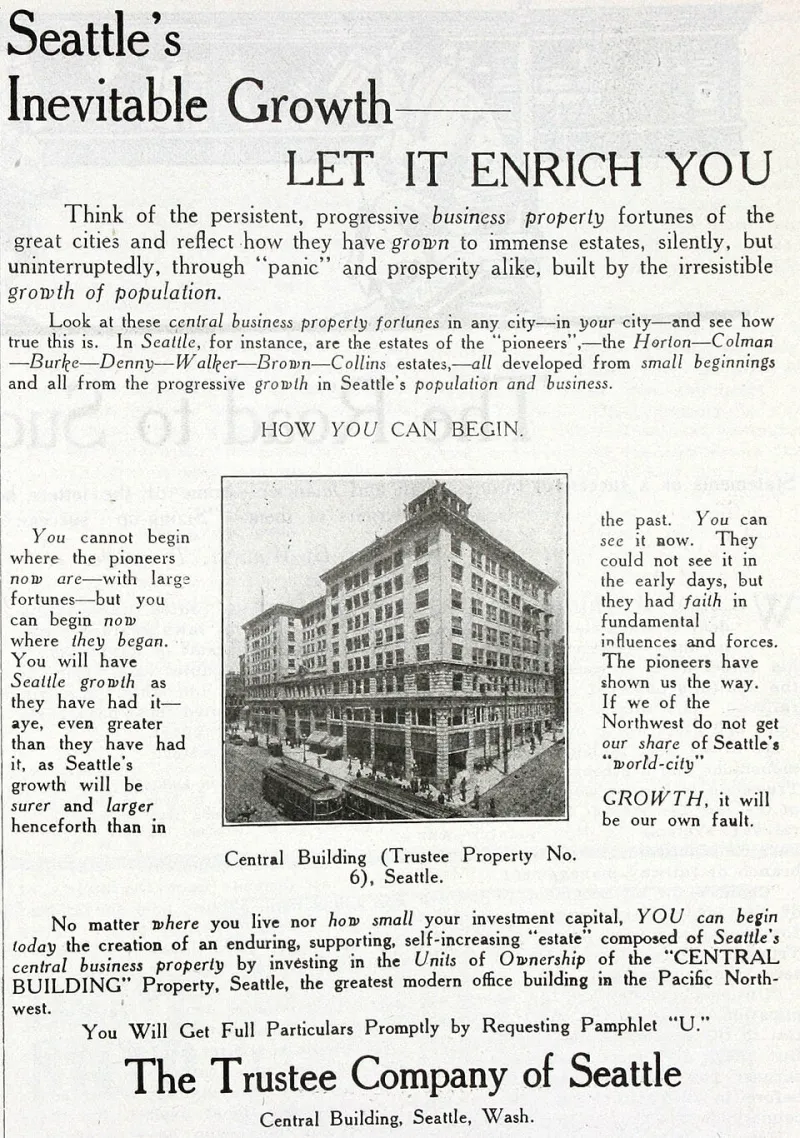
Photo: Trustee Company of Seattle, Public domain, via Wikimedia Commons
The skylines of American cities have always reflected the priorities of capital — and increasingly, that capital carries a Middle Eastern address. Over the past several years, sovereign wealth funds, royal family investment vehicles, and high-net-worth Arab investors have accelerated their deployment into US commercial real estate at a moment when many domestic institutional investors have pulled back, creating a dynamic that is reshaping ownership patterns, influencing valuations, and offering meaningful signals about where the property market may be headed.
For Arab investors evaluating their own real estate allocations — whether they are managing multi-generational family wealth or building a diversified portfolio from a US base — understanding the strategic logic behind this capital migration is both practically valuable and instructive.
The Macro Conditions That Created the Opening
The confluence of forces that drew Middle Eastern capital into US commercial real estate in large volumes is worth examining carefully, because it illustrates the kind of macro-level opportunity recognition that distinguishes sophisticated global investors.
Beginning in 2022, rising US interest rates triggered a significant repricing across commercial property sectors. Office valuations in major markets fell sharply as remote work adoption reduced occupancy rates and refinancing costs climbed. Retail and hospitality assets, still recovering from pandemic-era disruptions, traded at discounts that would have been unimaginable three years earlier. Domestic US real estate investment trusts and private equity funds, constrained by fundraising difficulties and existing portfolio stress, retrenched.
Gulf sovereign wealth funds and family offices, many of which maintain substantial US dollar reserves and operate with longer investment horizons than typical US institutional vehicles, recognized the dislocation as a structural entry point rather than a warning signal. With oil revenues elevated through 2022 and 2023, Gulf institutions had fresh capital to deploy at precisely the moment when US sellers were most motivated.
This counter-cyclical positioning — buying when domestic capital is retreating — is a hallmark of the most successful long-term real estate strategies, and Arab investors executed it with notable discipline.
Trophy Assets and the Logic of Landmark Ownership
The most visible dimension of Arab investment in US commercial real estate involves landmark properties in gateway cities. New York, Los Angeles, Chicago, and Washington DC have all seen significant transactions involving Middle Eastern buyers over the past decade, and the pace has quickened recently.
These acquisitions are not purely financial decisions. Ownership of iconic American real estate carries reputational and geopolitical dimensions that matter to sovereign entities managing national image alongside investment returns. A Gulf sovereign wealth fund that holds a stake in a recognized Midtown Manhattan tower is simultaneously making a financial investment and signaling economic sophistication and global integration to international audiences.
However, reducing Arab investment in trophy assets to symbolism would be analytically incomplete. The financial case for prime commercial real estate in supply-constrained US markets remains compelling over multi-decade horizons, particularly for investors whose home currencies carry volatility risk and who benefit from holding hard assets denominated in dollars. Class A office buildings in Manhattan, despite near-term occupancy headwinds, retain land value floors and replacement cost premiums that protect against permanent capital impairment in ways that financial assets cannot.
The Pivot to Industrial and Logistics Infrastructure
Perhaps more strategically revealing than the trophy asset acquisitions is the substantial Arab capital flowing into industrial real estate — warehouses, distribution centers, last-mile logistics facilities, and data center campuses across the American interior.
This allocation reflects a sophisticated read of structural economic trends. The reshoring of US manufacturing, the sustained growth of e-commerce fulfillment, and the explosive demand for data center capacity driven by artificial intelligence workloads are all generating durable demand for industrial space in markets that were historically considered secondary. Cities such as Columbus, Indianapolis, Phoenix, and the broader Inland Empire of Southern California have attracted significant Middle Eastern capital precisely because their industrial fundamentals are strong while their price points remain below gateway market levels.
For investors monitoring where Arab capital is flowing as a proxy for institutional conviction, the industrial and logistics sector warrants particular attention. When Gulf sovereign wealth funds — institutions with access to some of the most sophisticated real estate research available globally — concentrate allocation in a specific asset class, the signal carries weight.
Secondary Markets: Where the Real Opportunity May Lie
Beyond the headline transactions in major metros, a quieter but potentially more significant trend involves Arab capital moving into US secondary and tertiary markets. Residential-adjacent commercial assets — neighborhood retail centers, medical office buildings, and mixed-use developments in growing Sun Belt cities — are attracting interest from Arab family offices that are willing to accept lower immediate liquidity in exchange for stronger yield profiles and less competitive acquisition environments.
This secondary market orientation aligns with a broader diversification imperative. As gateway city commercial assets have been bid up by decades of global capital competition, the risk-adjusted return differential between primary and secondary markets has widened. Arab investors with genuine long-term holding capacity and less pressure to mark portfolios to quarterly benchmarks are structurally well-positioned to capture this premium.
Markets including Nashville, Raleigh-Durham, Salt Lake City, and Austin have all seen notable inflows of Middle Eastern capital into commercial development projects, often structured as joint ventures with local developers who provide market-specific operational expertise while Arab partners contribute capital and patient investment horizons.
What This Signals for US Property Markets
The sustained presence of Arab capital in US commercial real estate carries several implications that domestic investors should incorporate into their analytical frameworks.
First, it provides a partial demand floor beneath asset classes that might otherwise face more severe valuation corrections. When a distressed office portfolio in a major US city attracts competitive interest from Gulf sovereign funds, it constrains the downside scenario that purely domestic market dynamics might otherwise produce.
Second, it introduces a pricing variable that operates on different logic than traditional US institutional capital. Arab investors evaluating US real estate through a currency diversification and generational wealth preservation lens may sustain higher valuations for certain asset types than domestic return-on-equity calculations would justify — a dynamic that US investors need to account for when modeling acquisition opportunities.
Third, and most constructively, the sectors and geographies attracting concentrated Arab capital allocation represent a useful secondary indicator of structural economic trends. These investors are not speculating; they are making long-duration bets on where the American economy is heading. Following that analytical lead — while conducting independent due diligence — is a reasonable component of any sophisticated US real estate investment strategy.
Positioning for Arab-American Real Estate Investors
For Arab investors based in the United States, the current environment offers both direct participation opportunities and instructive benchmarks. Direct co-investment programs offered by Gulf institutional real estate platforms provide access to professionally managed portfolios with diversified US exposure. Indirect participation through publicly traded REITs with significant industrial and Sun Belt commercial exposure allows more liquid participation in the same structural trends driving Arab institutional allocation.
The most important takeaway, however, is strategic rather than tactical. The Arab capital flowing into US commercial real estate is not chasing short-term momentum — it is making considered, long-horizon bets on the durability of American economic geography. That orientation, applied with discipline and patience, represents a model worth emulating regardless of the specific assets in which one ultimately invests.