Rebalancing Against Uncertainty: How Arab Wealth Managers Are Engineering Multi-Polar Portfolios
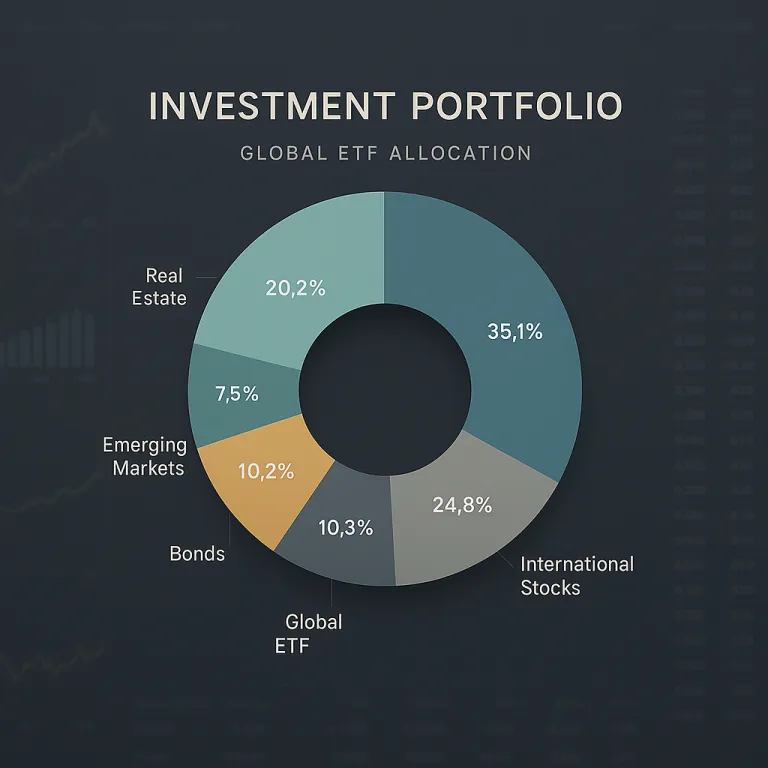
Photo: global investment portfolio map world regions financial diversification, via financialexpertclass.com
For decades, the gravitational pull of US capital markets was essentially irresistible for Arab institutional investors and high-net-worth families alike. The depth of American equity markets, the perceived safety of US Treasuries, and the dollar's reserve currency status made Washington the default anchor for portfolios stretching from Riyadh to Dubai. That calculus is shifting — not dramatically, not overnight, but with a deliberateness that wealth managers across the Gulf are now openly discussing.
The driver is not a loss of confidence in American economic fundamentals. Rather, it is the growing recognition that US policy risk — encompassing tariff regimes, sanctions architecture, regulatory pivots, and the turbulence of domestic political cycles — has become a material variable in portfolio construction. For Arab investors who often maintain significant business and financial ties to both the East and the West, that variable carries particular weight.
The Anatomy of US Policy Risk
To understand why Arab wealth managers are recalibrating, it helps to define what they mean by policy risk. This is not simply the possibility that a given administration will raise corporate taxes or tighten financial regulation. It encompasses a broader category of geopolitical and legislative uncertainty that can affect asset valuations, currency dynamics, and cross-border capital flows in ways that are difficult to model and nearly impossible to hedge cheaply within a US-centric portfolio.
Sanctions policy is one dimension. Arab investors with exposure to global trade networks are acutely aware of how swiftly the US Treasury's Office of Foreign Assets Control can reshape the financial landscape. Trade policy is another. The tariff disruptions that rattled global supply chains in recent years demonstrated that American commercial policy can move faster than institutional portfolios can adjust. Add to this the dollar's increasing weaponization as a geopolitical instrument, and the case for geographic diversification becomes structurally compelling rather than merely tactical.
Southeast Asia: The Anchor of the Eastern Rebalance
Among the alternative destinations attracting Arab capital, Southeast Asia stands out for its combination of demographic momentum, manufacturing diversification, and relative insulation from US-China bilateral tensions. Markets such as Vietnam, Indonesia, and the Philippines are absorbing investment flows that previously would have defaulted to US equities or real estate.
Arab family offices in particular have shown interest in private equity opportunities tied to Southeast Asia's expanding middle class — consumer goods, digital financial services, and logistics infrastructure. These are sectors that benefit from long-term structural growth rather than short-term policy cycles, making them attractive hedges against the volatility that political seasons in Washington can introduce.
Sovereign wealth funds from the Gulf Cooperation Council have also deepened their engagement with ASEAN economies, not merely through portfolio allocations but through direct investment frameworks and bilateral agreements that provide a degree of political insulation unavailable in publicly traded US assets.
Africa: Patient Capital Finds a Continent
Africa represents a longer-duration bet, but one that a growing cohort of Arab investors is willing to make. The continent's youthful population, expanding urban centers, and accelerating digital infrastructure buildout present a growth profile that contrasts sharply with the mature — and increasingly politically complicated — American market.
North African markets, given their geographic and cultural proximity to the Arab world, have historically attracted Gulf capital. But the current wave of interest extends further south, into sub-Saharan economies where mobile payments, agricultural technology, and renewable energy are creating investable opportunities at early-stage valuations. Arab investors who came of age watching Gulf sovereign funds deploy patient capital into long-horizon infrastructure projects are applying a similar philosophy to African markets.
The risk profile is undeniably different — liquidity is thinner, regulatory frameworks are less predictable, and currency dynamics require careful management. But for investors explicitly seeking to reduce their correlation to US policy cycles, those risks may be preferable to the headline risk that American political volatility now routinely generates.
Eastern Europe: Tactical Positioning in a Complex Landscape
Eastern Europe presents a more nuanced picture. The region's proximity to the ongoing conflict in Ukraine has introduced genuine geopolitical risk, but it has also created valuation dislocations that sophisticated investors are beginning to assess with fresh eyes. Poland, the Czech Republic, and the Baltic states — all beneficiaries of significant EU structural investment and NATO security guarantees — offer exposure to European growth dynamics without the premium valuations of Western European markets.
For Arab investors, the appeal is partly tactical. As US-Europe relations experience their own periodic strains, assets denominated in euros or Polish zloty provide a currency diversification benefit independent of dollar movements. Several Gulf-linked family offices have quietly increased allocations to Central and Eastern European real estate and private credit, sectors where the institutional investor base is less crowded than in Western Europe or the United States.
The Hedging Toolkit: Instruments Beyond Geography
Geographic diversification is the most visible component of this rebalancing, but it is not the only tool Arab wealth managers are deploying. Currency overlay strategies — designed to reduce dollar exposure without fully liquidating US positions — have become more sophisticated, with managers using options structures and non-dollar denominated bonds to manage the currency dimension of policy risk independently.
Gold remains a meaningful allocation for many Arab investors, not merely for its inflation-hedging properties but for its zero-counterparty-risk profile in a world where financial infrastructure itself has become a geopolitical instrument. Commodity-linked assets, particularly in energy transition metals, are also attracting capital as a hedge against scenarios where US industrial policy reshapes global commodity flows.
Alternative credit instruments — including sukuk issued by non-US sovereigns and multilateral development bank bonds — are providing fixed-income exposure that carries neither US interest rate sensitivity nor US policy risk in the same concentrated form as a Treasury-heavy portfolio.
Maintaining Growth Exposure Without Concentration Risk
A critical nuance in this rebalancing story is that Arab investors are not retreating from growth. The objective is not capital preservation through defensiveness but rather the construction of portfolios capable of generating competitive returns across a wider range of geopolitical scenarios. US equities remain a component of most institutional Arab portfolios — the American innovation economy, the depth of its capital markets, and the liquidity of its public securities are not easily replicated elsewhere.
What is changing is the concentration. Portfolios that once carried 50 to 60 percent US exposure are being deliberately restructured toward a more distributed architecture — one where no single political jurisdiction can unilaterally impair a majority of the portfolio through policy action.
For Arab investors who have long understood that geopolitical awareness is not optional but essential to wealth preservation, this is not a radical departure. It is, in many respects, a return to first principles: diversify across systems, not merely across sectors.
A Structural Shift, Not a Seasonal Trade
Wealth managers at major Gulf institutions are careful to frame this rebalancing as strategic rather than reactive. The allocations being made today in Jakarta, Nairobi, and Warsaw are not bets against America — they are bets on a world in which American policy is one variable among many, rather than the organizing principle of global capital allocation.
For Arab investors navigating the intersection of regional geopolitics, global market dynamics, and multigenerational wealth mandates, that distinction matters enormously. The portfolio of the next decade will not be defined by where capital flows most easily. It will be defined by where it can survive the widest range of political futures.